Fundraiser Planning Checklist for Nonprofits: Timeline to Day Sheet

Fundraiser Planning Checklist for Nonprofits: Timeline to Day Sheet
Start by setting a measurable fundraising goal, gross or net, with a firm deadline, then work a timeline checklist that moves from months out to days out and assigns an owner to budget, vendors, sponsorships, promotion, day-of logistics, and follow-up. Guidance from the National Council of Nonprofits backs this sequencing, and platforms exist to run that same checklist in one place. Below, you’ll find the full checklist along with a printable day sheet template.
TL;DR:
- Choose galas for donor cultivation and major gifts when you have months and budget; virtual events suit tighter timelines and distant supporters.
- In the example, $150 tickets with $40 catering leave $110 toward $8,000 in fixed costs, requiring about 73 sales before sponsorship or auction revenue.
- For tax receipts, subtract the fair market value of meals or entertainment from a donor’s payment; only the amount above that value is deductible.
- Send donor receipts and thank you notes within 48 to 72 hours, then deliver sponsor reports within two to four weeks and reconcile event finances.
Table of Contents
- Which type of fundraising event fits your goal?
- The complete fundraiser planning timeline: months to days out
- Building a realistic fundraiser budget and revenue model
- Sponsorship tiers: structure, pricing, and outreach
- Promotion, ticketing, and donation platform setup
- Who runs the event: roles, recruitment, and communication
- Day-of operations: the run-of-show and printable day sheet
- What to do after the event ends
- Risk and compliance checks before you launch
- Why checklist discipline raises your odds of success
- Jubiliq: one place to run this entire checklist
- FAQ
- Sources
Which type of fundraising event fits your goal?
Your event format should follow your goal, not the other way around. A gala or seated dinner tends to build deeper donor relationships and higher per-head giving, but it demands months of lead time and a bigger budget. A peer-to-peer run or walk spreads fundraising across many smaller gifts and works well for broad community reach. Auctions, live or silent, generate strong one-night revenue when you have accessible donated items. Virtual and hybrid formats lower overhead and widen your geographic reach, often in a tighter planning window.
Match the format to three factors: your primary goal (revenue versus relationship-building), your available staff and volunteer hours, and your realistic timeline.
- Galas and seated dinners favor donor cultivation and major gifts over fast cash.
- Auctions generate concentrated one-night revenue when you secure strong items early.
- Peer-to-peer runs and walks spread giving across a wide donor base.
- Virtual and hybrid galas cut venue and catering costs while reaching distant supporters.
- Community-driven events, like bake sales or local tournaments, work well for smaller budgets and new organizations.
The Council of Nonprofits recommends building a fundraising mix around three or four channels that fit your mission and team’s skills rather than chasing every format at once. Picking one or two event types and running them well beats spreading a small team across five different fundraisers.
The complete fundraiser planning timeline: months to days out
A fundraiser succeeds or fails on sequencing. Miss a step at the wrong time and everything downstream gets harder. Here is the checklist broken into planning phases, with the task and the owner who should carry it.
4 to 6 months out:
- Confirm your fundraising goal (gross and net) and set the event date.
- Choose your event type based on goal, audience, and team capacity.
- Draft a preliminary budget covering income and expense categories.
- Identify and book your venue and major vendors (catering, AV, rentals).
- Build a sponsorship prospectus with tier levels and pricing.
- Confirm any charitable solicitation registration requirements in your operating jurisdiction.
3 months out: 7. Finalize the venue contract and secure deposits. 8. Assign staff or volunteer leads for finance, sponsorship, volunteers, and logistics. 9. Begin sponsorship outreach using your prospectus. 10. Select your ticketing and donation platform and configure the event page. 11. Draft a promotion plan with key dates for email, social, and press.
1 to 2 months out: 12. Finalize auction items or program catalog. 13. Launch ticket sales and donation pages publicly. 14. Lock remaining logistics: seating, catering counts, rental orders. 15. Hold a training session for volunteers covering roles and check-in procedures. 16. Draft the run of show with approximate timing for each segment.
2 weeks to 1 week out: 17. Confirm vendor arrival windows in writing. 18. Print signage, programs, and name tags. 19. Run through the script with your MC and test AV equipment. 20. Finalize the seating chart and guest list, including dietary and accessibility needs.
Day of: 21. Distribute the printable day sheet to every lead with times, owners, and contact numbers. 22. Run check-in using a clear workflow with backup paper lists. 23. Issue donation receipts at the point of giving where possible. 24. Keep a contingency list for common problems: AV failure, vendor delay, weather.

Post-event (within 30 to 90 days): 25. Send acknowledgments and formal donor receipts. 26. Fulfill sponsor benefits and send a results report. 27. Reconcile actual revenue and expenses against budget. 28. Hold a lessons-learned meeting with your core team.
Pro Tip: Print the day sheet in a larger font than you think you need. Volunteers glance at it between tasks, not during a sit-down read.
Building a realistic fundraiser budget and revenue model
Your budget needs separate income and expense categories before you can project a believable net. On the income side, track ticket sales, sponsorships, silent and live auction proceeds, direct donations, and merchandise. On the expense side, track venue rental, catering, AV and rentals, insurance, marketing materials, and any paid staffing.
- Income categories: tickets, sponsorships, auction proceeds, direct donations, merchandise.
- Expense categories: venue, catering, AV/production, insurance, marketing, staffing.
- Break-even point: total fixed and variable costs divided by average net revenue per ticket or gift.
- Target net: total projected income minus total projected expenses, tracked weekly against actuals.
As an illustrative example only: if your fixed costs (venue, AV, insurance) total $8,000 and variable cost per guest (catering) is $40, with tickets priced at $150, each ticket nets $110 toward fixed costs after catering. You’d need roughly 73 tickets sold just to break even, before sponsorship or auction revenue.
One line matters for compliance: guidance on nonprofit fundraiser budgeting notes that the value of meals or entertainment provided to attendees must be separated from the tax-deductible portion of their payment, since only the amount above that fair-market value is deductible. Assign one finance lead to track actuals against budget weekly, not just at month-end.
Sponsorship tiers: structure, pricing, and outreach
A tiered sponsorship structure gives prospects a clear menu and gives your team a repeatable pitch. A common structure runs from an entry or bronze level up through silver, gold, and platinum, each adding benefits like event tickets, signage placement, program ad space, website mentions, and verbal recognition from the stage.
Outreach works best as a sequence rather than a single ask.
- Identify prospects from past donors, board connections, and local businesses aligned with your mission.
- Send a tailored proposal referencing the prospect’s specific interests, not a generic form letter.
- Follow up on a set schedule, typically one week and three weeks after the initial proposal.
- Put benefits and deadlines in a signed agreement before collecting payment.
- Confirm a fulfillment checklist and post-event reporting commitment up front.
Templates for building tiers and writing proposals are covered in a sponsorship package guide that walks through pricing and tax notes in more detail.
Promotion, ticketing, and donation platform setup
Your ticket and donation pages need to convert visitors quickly, which means clear ticket types, a visible refund policy, and a mobile-ready checkout. Build in promo codes for sponsors and partners, and offer table sales for groups alongside individual tickets.
Donation pages should offer suggested giving amounts, a recurring gift option, and simple data capture that feeds directly into your donor records, followed by an automated thank-you. Good field design also protects guest privacy, a point covered in a guide on registration form questions for event organizers.
- Ticketing checklist: ticket types, promo codes, table sales, refund policy, mobile checkout.
- Donation page checklist: suggested amounts, recurring option, data capture, automated thank-you.
- Promotion timeline: segmented email campaigns, a steady social cadence, partner amplification, and targeted press outreach.
- Technical checks: CRM integration, mobile optimization, and tracking conversion rate by traffic source.
Pro Tip: Send your first “save the date” email at the 3-month mark and your ticket-launch email the same week sales open. The gap between announcement and action should be short.
Who runs the event: roles, recruitment, and communication
Clear role ownership prevents the gaps that cause day-of scrambling. Assign one person to each core function well before the busy weeks begin.
- Event lead: owns the overall timeline and final decisions.
- Finance lead: tracks budget actuals and processes donations and receipts.
- Sponsorship lead: manages outreach, contracts, and fulfillment.
- Volunteer coordinator: recruits, schedules, and briefs the volunteer team.
- Logistics and AV lead: coordinates vendors, rentals, and run-of-show timing.
- Guest relations lead: oversees check-in, seating, and on-site guest questions.
Recruit volunteers six to eight weeks out and hold a training briefing in the final two weeks, giving each person a printed role sheet and a shift handoff time. Use a shared task list and a simple check-in sheet so leads know who is covering what, and keep an escalation contact list for anything that needs a quick decision.
Board members have a specific job here too. BoardSource notes that boards should move beyond simple endorsement into direct cultivation and solicitation tasks, which might mean making introductions, personally asking a handful of prospects, committing to attend, or helping review results afterward.
Day-of operations: the run-of-show and printable day sheet
Day-of success comes down to one document everyone can read at a glance: a printable day sheet listing times, tasks, owners, and contact numbers for every phase of the event. Build the run of show with enough detail that a volunteer who missed the training can still follow it.
- Confirm vendor arrival windows the week before, not the morning of.
- Run an AV and microphone check at least one hour before doors open.
- Set a clear check-in flow with a backup paper list in case of technical failure.
- Note accessibility needs: ADA seating, dietary restrictions, and clear signage.
- Give each volunteer shift a defined handoff time and a named replacement.
- Keep an emergency contact list visible to every team lead.
| Time | Task | Owner |
|---|---|---|
| 90 min before doors | AV and sound check | Logistics/AV lead |
| 60 min before doors | Vendor and catering arrival confirmed | Logistics/AV lead |
| 30 min before doors | Volunteer check-in and role sheet handout | Volunteer coordinator |
| Doors open | Guest check-in begins | Guest relations lead |
| Program start | Run of show begins per script | Event lead |
| Program close | Donation receipting and closing remarks | Finance lead |
Contingency decisions, like moving an outdoor segment indoors for weather, should sit with the event lead so no one waits for a committee vote mid-event.
What to do after the event ends
The days right after your event matter almost as much as the event itself. Send acknowledgments and formal donor receipts within a few days, using language that clearly states the tax-deductible portion of each gift. The National Council of Nonprofits points to timely, transparent acknowledgment as a core piece of ethical fundraising practice that builds donor trust for future asks.
- Send receipts and thank-yous within 48 to 72 hours of the event closing.
- Fulfill every sponsor benefit on the schedule promised in the contract.
- Send sponsors a short results report within two to four weeks.
- Reconcile actual revenue and expenses against the original budget.
- Document key metrics and hold a lessons-learned meeting with your core team.
- Segment donors for follow-up cultivation and send a short attendee feedback survey.
Separating controllable effort, like outreach volume, from uncontrollable results, like total raised, gives your team a fairer read on what worked, a distinction BoardSource’s effectiveness guidance also draws out.
Risk and compliance checks before you launch
A handful of overlooked legal steps can turn a successful fundraiser into a costly headache. Confirm charitable solicitation registration status, local permits, and any liquor or special-event permits your venue requires. Review vendor contracts for cancellation terms and confirm event insurance coverage early rather than the week before.
- Verify charitable solicitation registration and any required local permits.
- Confirm insurance coverage and review vendor contracts for cancellation terms.
- Set a gift acceptance policy, including who signs off on restricted gifts.
- Keep donor communications transparent and free of high-pressure tactics.
BoardSource’s risk management framework recommends identifying, evaluating, and prioritizing risks, then naming one coordinating lead who monitors and updates the plan as the event approaches. A detailed walkthrough of this process is covered in an event risk assessment guide with ready-to-use templates.
Why checklist discipline raises your odds of success
Most fundraiser problems trace back to a missed handoff, not a bad idea. A written, timed checklist turns individual memory into shared process, which matters most for small teams running their first or second event. The teams that repeat a documented timeline year over year tend to see fewer day-of surprises, because the same questions get answered the same way every time instead of being reinvented under pressure.
— HCRF
Jubiliq: one place to run this entire checklist
Running this checklist across spreadsheets, email threads, and sticky notes is where most of the handoff problems start. We provide a platform so you can run the same months-to-days timeline in one adaptive interface that shows only the tools a fundraiser actually needs, hiding irrelevant features.
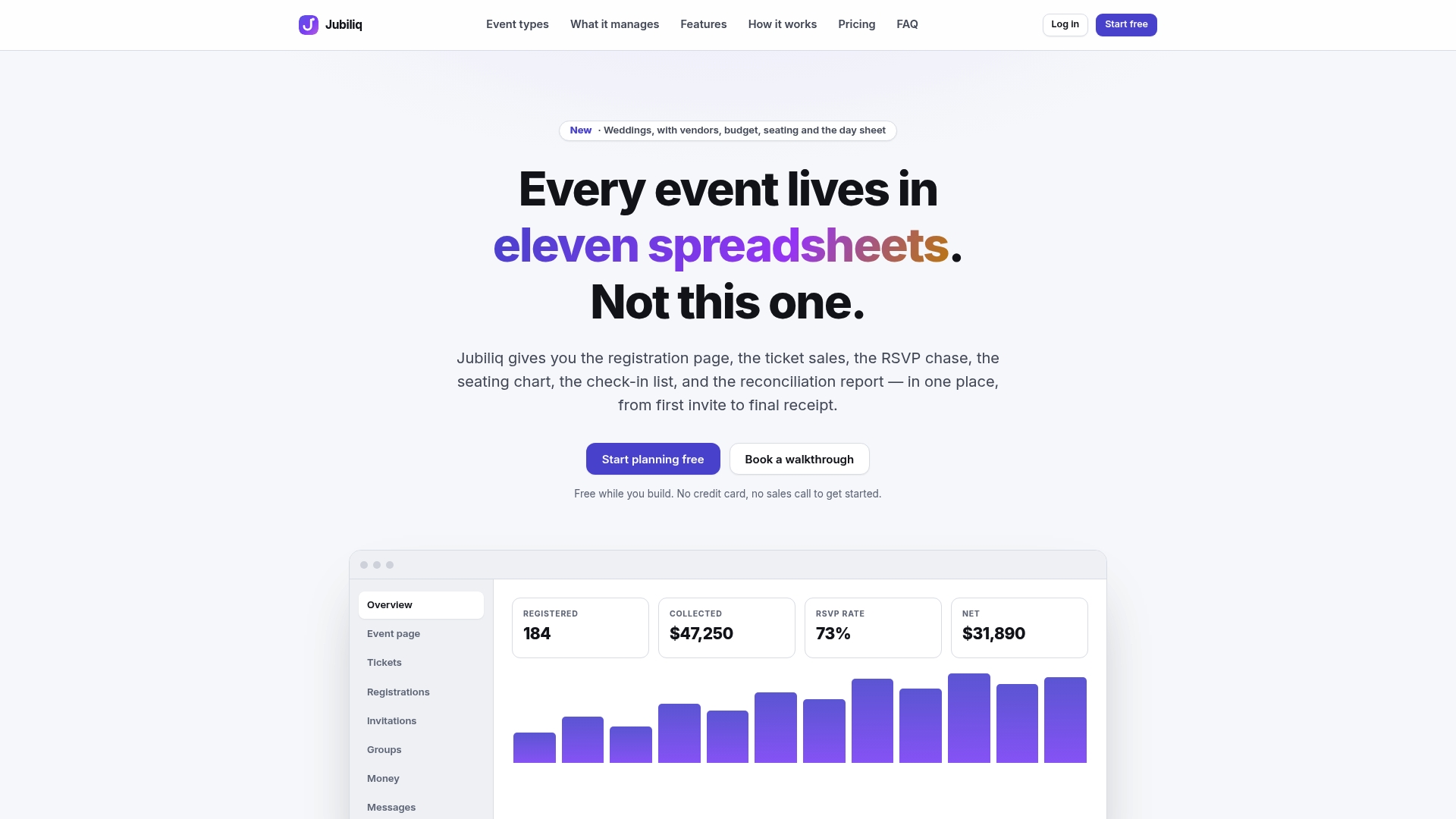
Inside one event, the platform handles RSVP and ticket sales, sponsorship and donation tracking, a live budget dashboard comparing actuals to plan, and a printable day sheet that pulls directly from your task list. Real-time updates help ensure team members are viewing consistent information instead of reconciling different versions.
- Adaptive planning interface built for fundraisers, hiding irrelevant tools automatically.
- Live budget tracking against your actuals, visible to your whole team.
- Integrated ticketing, donation handling, and segmented email blasts in one workflow.
- Printable day sheets generated straight from your task and timeline data.
Our Starter plan is free for planning-only use, and the Organizer plan runs at 2% per paid registration, so you only pay when a ticket or donation actually comes through. Compare plans and start your event at Jubiliq.
FAQ
What should be included in a fundraiser planning checklist?
A complete checklist covers goal-setting, event type selection, a budget, a timeline from months to days out, sponsorship outreach, ticketing and donation setup, volunteer roles, a day-of run of show, and post-event follow-up including donor receipts and reconciliation.
How far in advance should I start planning a fundraising event?
Most galas, auctions, and large community events need four to six months of lead time to secure a venue, build sponsorships, and promote ticket sales properly. Smaller or virtual events can run on a shorter one to two month window if your team and platform setup move quickly.
How do I create a budget for a nonprofit fundraiser?
List every income source (tickets, sponsorships, auctions, donations) and every expense category (venue, catering, AV, insurance, marketing) separately, then track actuals weekly against the plan. Guidance on nonprofit fundraiser budgeting also recommends separating the non-deductible value of meals or entertainment from the deductible donation amount for accurate receipting.
What roles do I need on a fundraising event team?
Core roles include an event lead, a finance lead, a sponsorship lead, a volunteer coordinator, a logistics and AV lead, and a guest relations lead. BoardSource also recommends giving board members specific fundraising tasks, such as introductions or direct solicitation, rather than a general ask for support.
What permits or registrations does a charity fundraiser need?
Requirements vary by jurisdiction, but many places require charitable solicitation registration before public fundraising and separate permits for alcohol service or large gatherings. Check your local requirements early, since BoardSource’s risk management guidance recommends confirming permits and insurance well before the event rather than in the final weeks.
Sources
Resources below cover deeper planning, board roles, and effectiveness benchmarking for nonprofits.
- Have a fundraising plan, work the plan, improve the plan | National Council of Nonprofits
- Boards’ role in fundraising | BoardSource
- How to create a budget for a nonprofit fundraiser | Dummies