Vendor Contract Terms for Events: Net 30 Depends on the Trigger Date

Vendor Contract Terms for Events: Net 30 Depends on the Trigger Date
Every vendor agreement needs the same handful of clause groups to function: scope of work, payment terms like Net 30, termination rights, liability and indemnity, confidentiality and IP, service levels, and dispute resolution. Get these right and you get fewer disputes, protected cash flow, and vendor obligations everyone can point to when something goes wrong.
TL;DR:
- Define deliverables, dates, dependencies, and measurable acceptance criteria in a signed statement of work, and state that the master agreement controls conflicts.
- Specify whether Net 30 starts at invoicing, delivery, or acceptance; require written disputes before payment is due and payment of undisputed amounts.
- Set written notice and a 10 to 30 day cure period for breach, then define cancellation refunds and preserve fees already earned.
- Set a liability cap and separate it from third party indemnity; require vendors to provide relevant insurance certificates before work begins.
- Name covered force majeure events, require prompt notice and mitigation, and allow termination without penalty if a disruption lasts beyond the agreed period.
Table of Contents
- 1. At-a-glance checklist for essential vendor contract clauses
- 2. Scope of work and Statements of Work: make deliverables measurable
- 3. Payment terms and invoicing: pick the right net period and triggers
- 4. Liability, indemnity and insurance: balance exposure with insurability
- 5. Termination, cancellation and refunds: notice, cure, and retainer rules
- 6. Confidentiality and intellectual property: ownership and permitted use
- 7. Service levels, performance metrics, and remedies for service vendors
- 8. Force majeure, risk allocation and business continuity for events
- 9. Contract structure, governance and annexes: making the master agreement authoritative
- 10. Practical negotiation checklist with sample phrasing and compromises
- 11. Jubiliq resources, templates and author credentials
- 12. Warranties and representations by the vendor
- 13. Compliance with applicable laws and regulations
- 14. Data protection and privacy obligations relating to vendor services
- 15. Practitioner perspective: one habit that prevents disputes
- 16. How Jubiliq helps organizers manage vendor contracts and avoid day-of surprises
- FAQ
- Sources
1. At-a-glance checklist for essential vendor contract clauses
Before you sign anything, run the agreement against this list. These are the clauses that show up in nearly every enforceable vendor agreement, and the ones most likely to get contested in event work.
- Scope of work: deliverables, dates, and acceptance criteria are specific, not described in general terms.
- Payment terms: the trigger date, due date, and dispute process are all defined, not implied.
- Termination: notice periods and cure rights are spelled out for both cause and convenience.
- Liability and indemnity: caps and carve-outs are stated, not left to default law.
- Confidentiality and IP: ownership of deliverables and handling of guest or sponsor data are explicit.
- Dispute resolution: governing law and venue are named.
In event contracts, vendors may push back on the scope of work, cancellation terms, and payment triggers during negotiation.
2. Scope of work and Statements of Work: make deliverables measurable
A vague scope of work is the single biggest source of vendor disputes, making an event decor vendor guide a useful resource for clarity when contracting décor and installation vendors. “Full-service catering for the reception” invites disagreement over headcount, timing, and menu substitutions. “Plated dinner for 150 guests, served between 6:30 and 7:15 PM, per the attached menu” does not.
A strong SOW includes a deliverables list, specific dates, measurable acceptance criteria, dependencies on the client or other vendors, and pricing broken into line items rather than one lump sum. Each deliverable should have a way to confirm it was done, not just a description of what “done” means in theory.
Watch for detached SOWs that contradict the master agreement, such as a floral vendor’s SOW setting different cancellation terms than the signed contract. Confirm in writing that the master agreement controls whenever a conflict exists between it and any SOW or purchase order.

3. Payment terms and invoicing: pick the right net period and triggers
Payment terms determine when money actually moves, and the trigger date matters as much as the term length. Net 30 is the most common U.S. B2B default, but Net 30 from invoice date can land weeks earlier than Net 30 from delivery or acceptance. Name the trigger explicitly: invoice date, receipt, delivery, or client sign-off.
Late fees and discounts need documentation too. A common structure charges 1.5% per month on overdue balances, or the maximum rate permitted by law, while offering a small discount, such as 2/10 Net 30, for early payment.
Build in a dispute process: require written notice before the due date, require payment of any undisputed portion, set a resolution window, and reserve the right to suspend services if payment stalls without notice.
4. Liability, indemnity and insurance: balance exposure with insurability
Liability caps and indemnity obligations do different jobs. A liability cap limits total damages one party owes the other, often set as a fixed dollar amount or a multiple of fees paid. Indemnity shifts the cost of third-party claims, like a guest injury claim against a caterer, from one party to the other.
Carve-outs matter on both sides. Intellectual property infringement and willful misconduct are commonly excluded from liability caps entirely, since capping damages for a deliberate breach removes any real deterrent.
Insurance requirements back up these promises with actual money. Reasonable requirements for event vendors include general liability coverage at a stated minimum, liquor liability for vendors serving alcohol, and a certificate of insurance naming the client as an additional insured before work begins. Requiring the certificate in advance, not after an incident, is what makes the requirement enforceable rather than theoretical.
5. Termination, cancellation and refunds: notice, cure, and retainer rules
Termination clauses separate two scenarios: termination for cause, triggered by a breach, and termination for convenience, which either party can invoke without fault. Cause-based termination typically requires written notice and a cure period, often 10 to 30 days, before the contract can end.
Event vendors need cancellation language tied to notice windows rather than a flat policy. State clearly that termination does not waive either party’s right to collect fees already earned.
Deposits and retainers need precise labels. “Non-refundable retainer securing the date” reads very differently from “deposit applied to the final invoice,” and the two should never be used interchangeably in the same document.
6. Confidentiality and intellectual property: ownership and permitted use
Deliverables created for an event, from a custom floral design to a branded event website, need a clear ownership statement. Work-for-hire language assigns full ownership to the client upon payment; a license grant instead lets the vendor retain ownership while granting the client rights to use the work. Decide which model applies before drafting, because the two produce very different outcomes if the relationship ends.
Confidentiality clauses should set a defined duration, list permitted disclosures such as to insurers or subcontractors, and address how guest lists, sponsor data, or donor information get stored and deleted after the event.
Pre-existing IP, like a vendor’s proprietary planning templates or lighting designs, should stay with the vendor by default, with only the finished, event-specific work assigned or licensed to the client.
7. Service levels, performance metrics, and remedies for service vendors
Service level agreements only work when the metrics are measurable. “Timely delivery” is not enforceable. “Rental items delivered and set up by 2:00 PM on the event date” is.
Useful KPIs for event vendors include response time to inquiries, delivery and setup windows, and firm deadlines for materials like printed programs or signage. Each metric needs a remedy attached: a service credit for a missed delivery window, a short cure period for a fixable failure, and a termination right if failures repeat across multiple events or milestones.
Vague SLA language is the most common reason these clauses fail in practice. A clause that promises “reasonable effort” or “prompt service” gives a vendor room to argue they met the standard no matter what happened, while a clause tied to a specific time and date leaves little room for debate.
8. Force majeure, risk allocation and business continuity for events
Force majeure clauses excuse performance when something outside either party’s control makes it impossible, but only for the events the clause actually names. Generic language covering “acts of God” may not clearly reach a pandemic, a hurricane, or a government-ordered venue closure unless those are listed specifically.
A workable clause requires prompt written notice once a triggering event occurs, imposes a duty to mitigate (rescheduling instead of canceling where possible), and allows suspension of obligations rather than automatic termination for short disruptions. For a prolonged event, such as a force majeure event lasting more than 30 or 60 days, either party should be able to terminate without penalty.
Tie force majeure to your insurance coverage and contingency plans for any vendor considered critical to the event running at all.
9. Contract structure, governance and annexes: making the master agreement authoritative
A master services agreement should state plainly that it governs the relationship, with every SOW, purchase order, and amendment incorporated by reference and subject to the master’s liability, confidentiality, and termination terms. Simple language works: “In the event of conflict between this Agreement and any SOW, this Agreement controls.”
Change orders need their own mechanic: a written request describing the change, its cost impact, and a signature from both parties before it takes effect. Verbal agreements to add scope mid-event create exactly the disputes this structure is meant to prevent.
Unsigned attachments, email threads, and invoice line items should never be allowed to alter core commercial terms like price, payment timing, or liability caps. If a change matters, it belongs in a signed amendment.
10. Practical negotiation checklist with sample phrasing and compromises
Negotiating vendor terms goes faster with a mapped checklist and fallback positions ready before the call.
- Scope: push for a detailed SOW; fallback is a short scope letter with a 30-day window to formalize it.
- Payment: ask for Net 30 from delivery, not invoice date; fallback is a 2/10 Net 30 early-payment discount.
- Termination: request a 15-day cure period; fallback is 30 days with written notice.
- Liability: propose a cap tied to fees paid; fallback is a cap tied to total contract value.
- Cancellation: propose a tiered refund schedule; fallback is a clearly stated deposit forfeiture.
Sample phrasing to offer a vendor directly: “Payment is due within 30 days of client acceptance of deliverables, not invoice date,” or “Either party may terminate for convenience with 30 days’ written notice, without affecting fees already earned.”
Pro Tip: Keep a clause library of your preferred phrasing for scope, payment, and termination so you are editing a familiar template instead of starting from a vendor’s draft every time.
11. Jubiliq resources, templates and author credentials
Vendor contract management works better when the contract terms live next to the rest of the event, not in a separate folder. Our platform brings event planning details together, helping organizers keep track of important information throughout the planning process.
For event-specific clause examples, our posts on contract cancellation clauses, refund policy language, and hotel room block terms walk through annotated sample language for the clauses organizers negotiate most often. This article was written by HCRF; downloadable checklists and templates referenced throughout live on our blog alongside these deeper guides.
12. Warranties and representations by the vendor
A warranty is a vendor’s statement that something is true now or will remain true during the contract, and it gives the client grounds to act if the statement turns out to be false. For event vendors, useful warranties include a promise that the vendor holds any required licenses or permits, that deliverables will be free of defects for a stated period, and that the vendor has the right to provide the services or goods without infringing a third party’s rights.
Representations differ slightly: they are statements of fact made at a point in time, often at signing, such as “vendor has no pending litigation that would affect performance.” Breaching a representation can give the client grounds to void the contract, while breaching a warranty typically triggers a remedy like repair, replacement, or a refund.
Keep warranty language specific. “Vendor warrants good workmanship” is hard to enforce. “Vendor warrants that all rental equipment will be in safe working condition at delivery and will be replaced promptly if found defective” gives both sides a standard to measure against.

13. Compliance with applicable laws and regulations
A compliance clause requires the vendor to follow the laws, licenses, and permits that apply to their services, from food-handling certifications for a caterer to fire-code compliance for a tent or stage installation. This clause shifts responsibility for regulatory failures onto the party best positioned to know the rules governing their own trade.
For international vendor relationships, parties whose places of business sit in different countries may fall under the CISG for contracts involving the sale of goods, unless the contract specifically opts out or chooses a different governing framework. Naming the applicable law directly in the contract avoids uncertainty about which rules apply if a dispute crosses borders.
A compliance clause should also require the vendor to notify the client promptly if a license lapses or a regulatory issue arises that could affect performance, rather than leaving the client to discover it on event day.
14. Data protection and privacy obligations relating to vendor services
Event vendors frequently handle guest, sponsor, or donor information, from RSVP contact details to payment data collected for ticket sales. A data protection clause should state what the vendor can do with that information, how long they retain it, and what happens to it once the event concludes.
At minimum, the clause should require the vendor to use attendee data only for the purposes of the event, prohibit sharing it with third parties without consent, and require secure deletion or return of the data within a set period after the event ends. Where sensitive information is involved, such as dietary restrictions tied to health conditions or payment card data, the contract should require the vendor to follow applicable data protection and payment card security standards for that category of information.
This is worth drafting carefully alongside your guest communication and RSVP process, since the people whose data is being protected are the same guests your communication plan is built around.
15. Practitioner perspective: one habit that prevents disputes
Event contract disputes can arise when a scope of work is vague or a cancellation clause goes unread until someone needs to cancel. The habit that prevents both is simple. Consider requiring a signed SOW and a completed clause checklist before accepting a deposit, even for a vendor you have used before.
— HCRF
16. How Jubiliq helps organizers manage vendor contracts and avoid day-of surprises
Once the clauses are negotiated, the harder part is keeping track of them across every vendor on an event. We built our platform so vendor details, contract notes, and payment deadlines live in one place instead of scattered across email threads and PDFs.
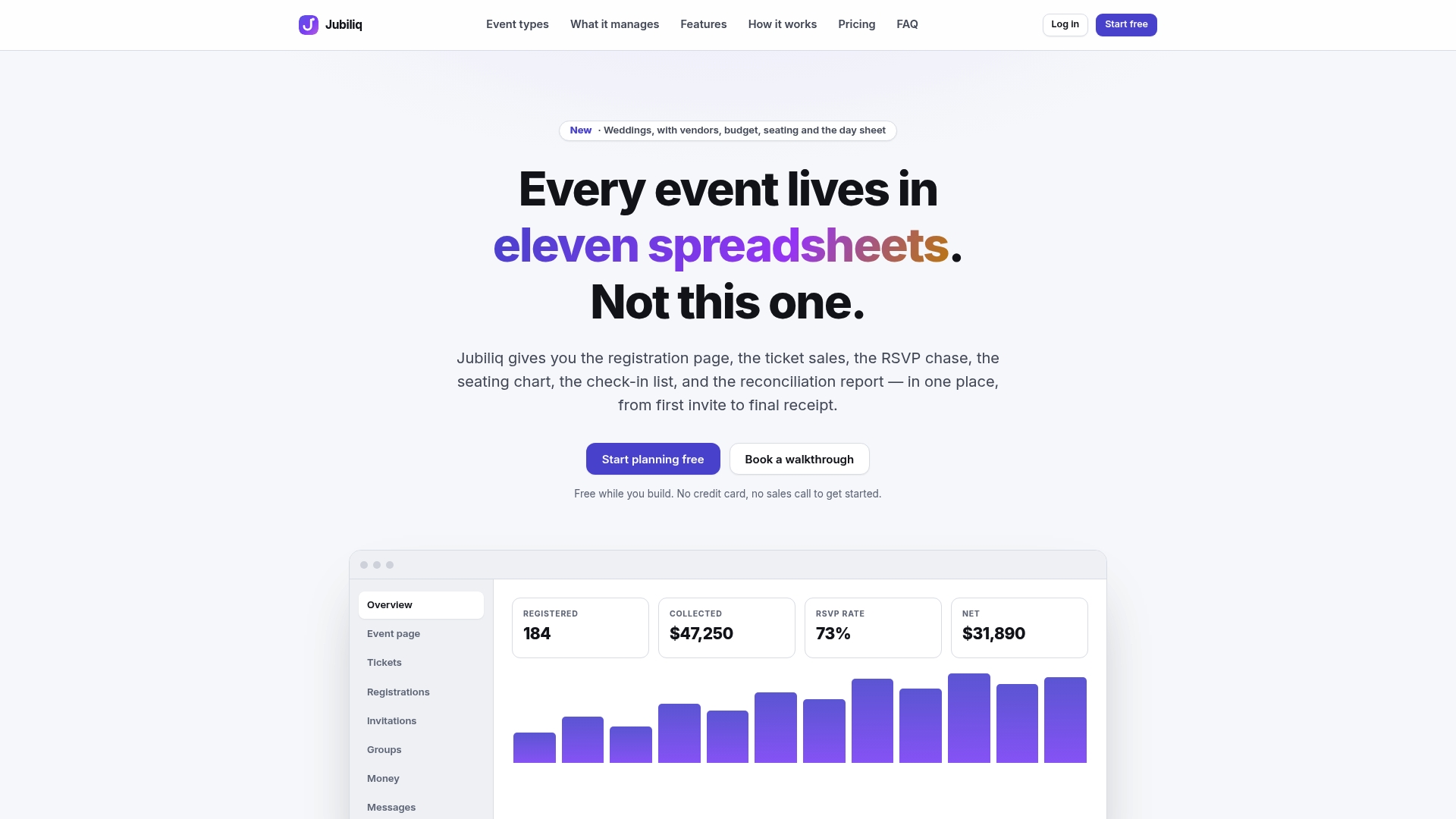
Our event planning tools are available through our Starter and Organizer plans centralize this for any event, whether you are planning a wedding with zero paid tickets or a fundraiser selling registrations. Check which plan fits your next event.
FAQ
What are the 6 requirements of a contract?
Courts generally look for four core elements to form an enforceable contract: mutual assent, consideration, capacity, and a lawful purpose. Some practitioners add a fifth and sixth requirement, like definiteness of terms and genuine consent, but the four core elements are what most U.S. courts require.
What is a vendor agreement?
A vendor agreement is a contract between a business and a supplier that sets out what the vendor will deliver, what the client will pay, and how each party’s obligations and risks are allocated. For events, this typically covers services like catering, venue rental, photography, or décor.
Which four items should be included in any vendor contract?
At minimum, a vendor contract needs a clear scope of work, payment terms with a defined due date, termination rights with notice periods, and liability or indemnity language. These four appear in nearly every enforceable vendor agreement regardless of industry.
Can you write your own contract agreement?
Yes, parties can draft their own contract as long as it meets the basic requirements for a valid agreement, including mutual assent and consideration. Many procurement teams prefer using their own standard terms rather than a vendor’s template, since a vendor’s own form often favors the vendor on liability and pricing flexibility.
Sources
- contract | Wex | US Law | LII / Legal Information Institute
- United Nations Convention on Contracts for the International Sale of Goods (Vienna, 1980) (CISG) | United Nations Commission on International Trade Law
- Payment Terms: What’s Standard (2026)
- Invoice payment terms: definitions, examples, and tips | Xero US